
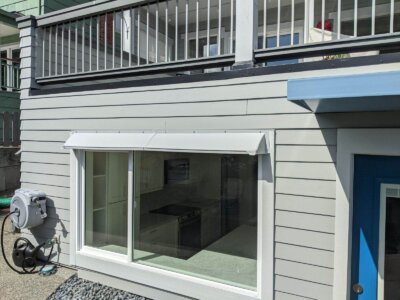
A leaking window usually gets blamed on the window itself. Sometimes that is true. Just as often, the real problem is the amount of rainwater hitting the top of the opening and running back into joints, trim, siding, or masonry. In that situation, the right window awning to stop leaks is not a decorative add-on. It is a practical water-management fix.
That distinction matters. If water is pouring down a wall, splashing off siding, or tracking behind trim, caulk alone rarely solves it for long. You need to reduce direct exposure, create outward projection, and move runoff away from the vulnerable area. That is where a properly designed rain guard or awning-style diverter earns its keep.
What a window awning to stop leaks actually needs to do
A lot of products look like they should help with water intrusion. Many do very little once a hard rain hits from the wrong angle. To stop leaks consistently, the cover above a window needs enough projection to push water away from the wall, not just drip it off the face. It also needs a shape that controls runoff instead of letting water curl back underneath.
This is where basic metal drip edges often come up short. They may shed some water, but they do not provide much forward throw. If the wall surface is uneven, or if the leak is being driven by heavy roof runoff, splashing, or wind-blown rain, a shallow flashing profile may not be enough. A deeper awning-style cover with an integrated front gutter gives water a path out and away before it can work into the top corners or frame.
That is the difference between a cosmetic cap and a purpose-built leak solution. One changes the appearance. The other changes water behavior.
Why windows leak from above even when the window seems fine
Property owners often replace sealant, repaint trim, or even plan for a full window replacement before confirming the source of the leak. That can get expensive fast. A leak that appears at the top of a window does not always mean the glass unit or sash has failed.
Water may be entering from failed siding joints above the opening, from stucco cracks, from poor head flashing, from fastener penetrations, or from runoff concentrated by a roofline. On metal buildings and sheds, water may follow panel ribs or seams. On older homes, trim details and settled surfaces can create small channels that repeatedly direct water toward the same weak spot.
The symptom is water inside or around the window. The cause is often repeated water loading on the exterior above it.
That is why a window awning to stop leaks can make sense even before major tear-out work. If the core issue is exposure, reducing exposure is a direct fix. If the problem is a hidden defect that still needs repair, a rain-diverting cover can still reduce further damage while you plan the permanent work.
When an awning-style rain diverter is the better choice
Not every leak needs the same answer. If a window has rotten framing, failed glazing, or major wall damage, a cover alone is not the whole repair. But there are many real-world cases where adding overhead protection is the most efficient step.
It makes the most sense when the leak gets worse during driving rain, when staining starts at the top corners, when water drips after running down the wall, or when previous caulking repairs keep failing. It is also a strong option for basement windows, utility room windows, shed windows, and metal-building openings where replacement is hard to justify but water intrusion needs to stop.
For facility managers and maintenance crews, this is often the practical middle ground. Instead of rebuilding wall sections immediately, they can intercept and redirect runoff at the point of entry risk. That can stop active leaking, reduce mold risk, and prevent damage to trim, framing, finishes, and hardware.
How to choose the right window awning to stop leaks
Start with projection. This is the feature most buyers underestimate. If the cover barely extends beyond the wall, it will not move enough water away from the opening. A stronger projection provides a better drip line and better defense against splash-back and wind-driven flow.
Next, look at whether the design includes real guttering or just a bent edge. A front gutter changes performance. It catches runoff and directs it outward in a controlled way rather than allowing water to sheet unpredictably off the front lip.
Material matters too. Rust-prone metal can stain, corrode, and lose appearance over time, especially in exposed conditions. A rust-proof ABS cover avoids that issue and is well suited for long-term outdoor use. It also helps when the goal is low maintenance, especially on residential windows, service buildings, and utility areas where nobody wants to keep repainting or replacing parts.
Width is another key factor. The cover should extend beyond the vulnerable area on both sides, not stop exactly at the frame width. Extra overlap helps catch runoff that would otherwise wrap around the corners. In many leak scenarios, those top corners are where water finds its way in.
Finally, think about the mounting surface. Brick, stucco, siding, steel panels, and rough masonry all behave differently. The best product in the wrong size or poorly matched to the wall can underperform. That is why exact dimensions and realistic installation planning matter more than style.
Installation matters as much as the product
A good cover can only do its job if it is installed high enough and fastened properly. The goal is to protect the opening, not crowd it. The awning should sit above the window with enough clearance to intercept runoff before it reaches the top trim or head area.
Fastening should be secure and appropriate for the wall type. On uneven surfaces, sealant strategy and mounting technique become more important because gaps behind the back edge can create paths for water. On corrugated or ribbed metal, you may need to account for profile irregularities. On stucco or textured masonry, the installer needs to pay attention to contact points and seal continuity.
This is also where many generic store-bought options fail. They are often sold as simple weather add-ons, but real leak control depends on dimensions, projection, and installation detail. A purpose-built rain diverter gives you a better chance of solving the problem the first time.
Common mistakes that keep window leaks going
The first mistake is treating every leak as a caulk problem. Caulk has a role, but it cannot overcome bad water control. If runoff keeps hammering the same area, sealant becomes a maintenance cycle, not a solution.
The second mistake is choosing a narrow cap with minimal overhang because it looks cleaner. A shallow profile may help with minor drips, but it often does not provide enough throw to stop recurring leaks. Water management is performance-first. Appearance comes second.
The third mistake is sizing too tight. If the cover does not extend past the opening, side wraparound can still feed water into the vulnerable edges. More overlap usually means better protection.
The fourth mistake is ignoring the source of runoff. If a roof edge, upper trim line, or wall seam is sending extra water toward the window, you need a product that can handle that volume. It depends on the exposure level. Light rain on a sheltered wall is one condition. Heavy runoff on an unsheltered wall is another.
A practical alternative to expensive tear-out
For many owners, the question is not whether a full repair is ideal. It is whether that repair is necessary right now. If the leak is exposure-driven and the window unit is otherwise serviceable, a well-designed diverter can prevent further damage without jumping straight to replacement.
That makes this type of product especially useful on older homes, basement windows, outbuildings, service doors with adjacent windows, and commercial or industrial openings where function matters more than architectural detailing. It is also a smart move when you want immediate protection while sorting out broader envelope repairs.
A product like the awning-style rain diverters made by DOORBRIM is built around that exact problem. The deeper projection, integrated front gutter, rust-proof ABS construction, and practical sizing options are not decorative features. They are the reasons the product performs better than flat flashings and shallow metal drip caps in real leak conditions.
If water keeps showing up at the top of a window, do not assume the only answer is replacing the window. Sometimes the better fix is stopping the water before it gets there.
Share this:

Discover more from DOORBRIM Rain Diverters
Subscribe to get the latest posts sent to your email.
You must be logged in to post a comment.